
What Is a Trampoline Manufacturer and How to Choose One?

A trampoline manufacturer does more than assemble jumping mats and steel frames. It designs, tests, produces, and supports equipment intended for repeated impact. Some companies manufacture every major component. Others outsource frames, springs, or safety nets and complete final assembly. That difference matters.

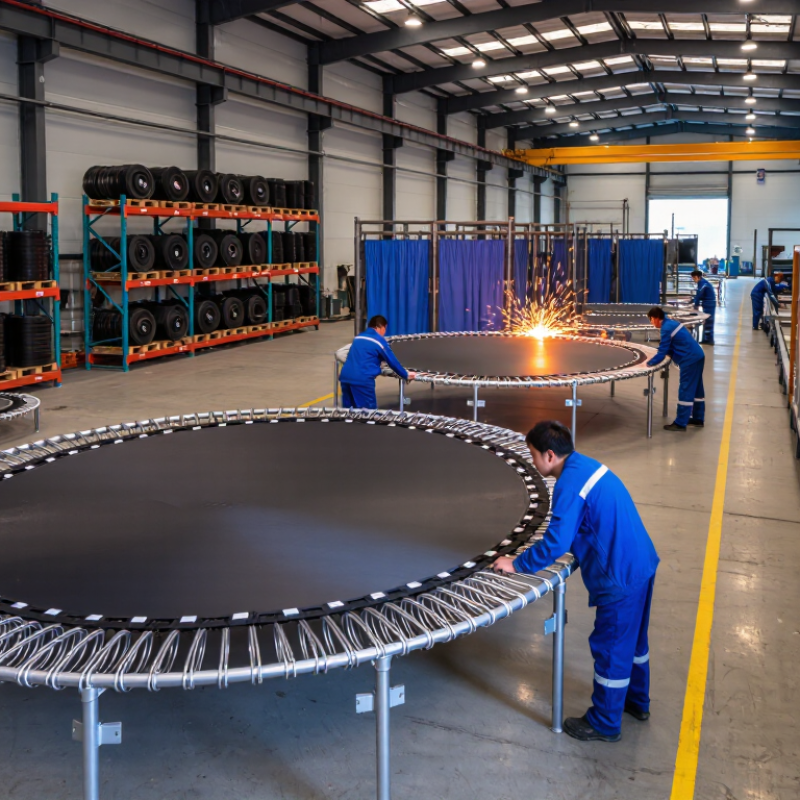
Trampoline Manufacturers should be assessed through evidence, not attractive product photos. A dependable supplier can explain its steel grades, welding process, spring treatment, mat stitching, and padding density. It should also provide clear inspection records and product documentation. Visit the factory when possible. Look at the welding stations, material storage, quality checkpoints, and packaging area. Small details often reveal production discipline.

Safety deserves careful attention. Ask how the frame is tested under repeated loads, how UV exposure affects outdoor materials, and how replacement parts are supplied. Recognized testing reports can strengthen confidence, but certificates should be verified with their issuing organizations. A confident sales presentation is not proof of consistent quality. Neither is the lowest quotation.

Manufacturing capacity also affects your decision. A suitable partner should handle your order volume, customization needs, lead time, and after-sales responsibilities. Request samples before approving a large purchase. Check whether the sample matches the final specification. That step is easy to skip.

The selection process is not perfectly predictable. Even experienced buyers can overlook packaging damage, changing material costs, or weak communication after payment. A written specification, staged inspections, and realistic service agreements reduce those risks. The best manufacturer is not always the largest one. It is the partner that combines technical control, transparent communication, verified quality, and dependable support.
What Is a Trampoline Manufacturer and How to Choose One?

What Is a Trampoline Manufacturer?

What Is a Trampoline Manufacturer?

A trampoline manufacturer is a company that designs, produces, and tests trampolines. It may build backyard, fitness, or commercial models. Unlike a simple reseller, the manufacturer controls important production steps. These steps can include frame forming, spring selection, mat stitching, padding assembly, and final inspection.

A professional manufacturer begins with engineering details. Engineers consider frame thickness, weld quality, jumping-mat tension, and weight limits. Workers may check each seam beside a bright inspection lamp. They may also measure frame joints with gauges before packaging. Reliable factories keep material records and testing reports. These documents help buyers understand how a product was made, not just how it looks online.

A manufacturer should also explain its quality process clearly. Ask about sample testing, replacement parts, packaging protection, and production experience. A low price can hide thin padding or inconsistent springs. However, an expensive product is not automatically better. No factory is flawless. A careful buyer should review evidence, ask direct questions, and inspect a sample when possible. One overlooked detail, such as a loose stitching line, can affect long-term use. Manufacturer claims deserve attention, but they still need practical verification.

What Products and Services Does a Trampoline Manufacturer Provide?

A trampoline manufacturer does more than produce jumping frames. It develops complete recreation systems for homes, schools, fitness centers, and commercial parks. Common products include round and rectangular trampolines, safety nets, padded frames, ladders, anchor kits, replacement springs, and weather-resistant covers.

Commercial manufacturers may also provide custom layouts, in-ground designs, foam pits, access platforms, and modular jumping zones. Installation support matters. A poorly leveled frame can create uneven movement and premature wear. Some manufacturers offer site measurements, assembly guidance, inspection schedules, staff training, and maintenance plans. These services reveal practical experience beyond a product catalogue.

According to Grand View Research, the global trampoline market is expected to grow at roughly 4% annually through 2030. That growth increases product choices, but it can also hide quality differences. A manufacturer should explain load ratings, material specifications, testing procedures, and replacement-part availability. Safety documentation should reference recognized standards, such as ASTM requirements for trampoline equipment. The U.S. Consumer Product Safety Commission has repeatedly reported tens of thousands of trampoline-related emergency visits annually, showing why safety cannot be treated as decoration. Ask for inspection records and clear warranty terms. Marketing language alone is weak evidence. Even experienced manufacturers may have service gaps, especially with overseas parts or delayed replacements. A careful buyer should test the support process before placing a large order.

How Does the Trampoline Manufacturing Process Work?

A trampoline manufacturer turns a safety-sensitive design into a repeatable product. The process usually starts with load calculations, frame drawings, and material selection. Engineers choose steel tubing, spring dimensions, jumping-mat fiber, and netting strength. Grand View Research’s 2023 market analysis reported steady global trampoline-market growth, increasing pressure for consistent production and documented quality.

Steel tubes are cut, bent, welded, and coated against corrosion. Workers then inspect welds for gaps, sharp edges, and uneven penetration. Springs receive dimensional checks and fatigue testing, while the mat is examined for stitching strength and ultraviolet resistance. The frame is assembled on a test fixture, not only on a showroom floor. ASTM F381 provides recognized safety guidance for trampoline construction, labeling, and performance. A serious factory should show test records, batch numbers, and corrective-action reports.

Quality teams also perform repeated loading, enclosure-impact, and stability tests. Historical U.S. Consumer Product Safety Commission data estimated over 100,000 trampoline-related emergency-department visits annually. That figure reminds buyers that small manufacturing errors matter. No factory is flawless. A manufacturer that admits failed samples and explains redesigns may be more reliable than one showing only perfect photographs. Ask how often inspections occur, who signs them, and whether independent laboratories verify the results.

What Is a Trampoline Manufacturer and How to Choose One? - How Does the Trampoline Manufacturing Process Work?

Manufacturing Area Typical Materials or Specifications How the Process Works Important Quality Checks What Buyers Should Evaluate
Frame Design and Fabrication Galvanized steel tubing is commonly used for outdoor frames because zinc coating helps protect steel from corrosion. Tube diameter and wall thickness vary by product size and load requirements. Steel tubing is cut, bent, drilled, welded, and finished to create the circular or rectangular frame and supporting legs. Check weld consistency, tube dimensions, joint alignment, sharp edges, coating coverage, rust resistance, and frame stability under load. Ask for material specifications, corrosion-resistance information, dimensional drawings, load-test records, and samples from the same production process.
Jumping Mat Production Polypropylene fabric is widely used for jumping mats because it is lightweight, flexible, and resistant to repeated stretching. UV-resistant treatments may improve outdoor durability. Fabric is cut into the required shape, reinforced around the perimeter, and connected to spring attachment points using industrial stitching and webbing. Inspect stitch density, seam strength, attachment-point spacing, fabric tension, surface defects, and resistance to repeated cyclic loading. Confirm fabric composition, UV performance, maximum user capacity, replacement-mat availability, and compatibility with the frame and springs.
Spring Manufacturing and Treatment Springs are generally made from high-carbon spring steel. The wire diameter, coil length, number of turns, and installed tension must match the trampoline design. Steel wire is formed into coils, heat-treated to achieve the required spring properties, and finished with a protective coating where applicable. Measure free length, wire diameter, coil uniformity, tensile performance, corrosion protection, and resistance to fatigue after repeated extension cycles. Request spring specifications, fatigue-test results, corrosion-test information, and confirmation that replacement springs are available.
Safety Pad Manufacturing Common constructions include closed-cell foam covered with UV-resistant PVC or polyethylene-coated fabric. Closed-cell foam absorbs less water than open-cell foam. Foam is cut to size, covered with an outer material, sewn or heat-sealed, and fitted with straps or fasteners for attachment to the frame. Check foam thickness and recovery, cover tear resistance, seam strength, attachment security, weather resistance, and coverage of the frame and springs. Compare padding thickness, coverage width, UV resistance, drainage performance, replacement cost, and fit after installation.
Safety Enclosure System Enclosures typically use UV-stabilized polyethylene or polypropylene netting, steel or fiberglass poles, protective sleeves, and a secured entry opening. Netting is cut and sewn, pole channels are formed, and the enclosure is attached to the frame or mat according to the product design. Check mesh integrity, seam strength, pole flexibility, attachment points, entry closure, net tension, and the absence of openings that could trap fingers or limbs. Verify enclosure height, access design, replacement-net availability, UV resistance, installation instructions, and compliance with the target market's safety requirements.
Surface Finishing Outdoor steel parts may use hot-dip galvanizing, electro-galvanizing, or powder coating. The suitable finish depends on the expected environment and product design. Metal parts are cleaned and prepared before a protective coating is applied. Powder coating is cured with heat; galvanizing bonds zinc to the steel surface. Inspect coating uniformity, adhesion, exposed metal, blistering, scratches, coating thickness, and corrosion performance. Select a finish appropriate for humidity, coastal exposure, temperature, and intended service life; request coating and corrosion-test documentation.
Assembly and Functional Testing The finished product includes the frame, legs, springs, mat, safety pads, enclosure, fasteners, and installation hardware. Components are assembled according to engineering drawings, then checked for fit, alignment, tension, stability, and correct operation of the enclosure. Perform dimensional inspection, stability checks, repeated-use or cyclic tests, fastener checks, packaging inspection, and review of assembly instructions. Require a documented quality-control plan, pre-shipment inspection procedure, traceability system, and clear corrective-action process.
Safety and Regulatory Compliance Requirements differ by destination and product category. Relevant standards may address structural integrity, entrapment hazards, impact areas, labeling, and user instructions. The manufacturer designs, tests, labels, and documents the trampoline against the requirements applicable to the intended sales market. Review current test reports, certificates, warning labels, manuals, age guidance, maximum user weight, and product identification records. Specify the destination market before production and independently verify that documents apply to the exact model, materials, and configuration being purchased.
Packaging and After-Sales Support Packaging normally includes cartons, protective inserts, hardware bags, installation instructions, safety information, and spare-part references. Components are protected against abrasion and moisture, packed by assembly step, labeled, and prepared for transport and warehouse handling. Check carton strength, moisture protection, component count, instruction accuracy, barcode or batch traceability, and transport-damage procedures. Evaluate spare-part lead times, warranty terms, installation support, response times, packaging test results, and long-term product-service capability.

Which Factors Matter When Choosing a Trampoline Manufacturer?

Choosing a trampoline manufacturer requires more than comparing prices. The factory’s testing process, material control, and production experience matter more. Look for manufacturers that can explain frame steel grades, spring fatigue testing, UV-resistant fabrics, and enclosure strength. Ask for test records, inspection procedures, and product traceability.

Safety evidence should guide the decision. The American Academy of Pediatrics has reported nearly 100,000 trampoline-related injuries annually in the United States. This figure shows why reliable construction is not a cosmetic advantage. A serious manufacturer should reference applicable ASTM requirements and provide documented quality checks. Independent laboratory testing adds credibility, especially for commercial installations. Grand View Research has also identified steady growth in the global trampoline market, increasing pressure on factories to scale without weakening quality.

Capacity deserves careful examination. A large catalog does not prove dependable production. Request samples from current production lines, not specially prepared units. Check weld consistency, stitching, padding thickness, packaging, and replacement-part availability. Communication is another practical test. Can the supplier answer technical questions clearly? Can it correct a defect without excuses? The cheapest quote may become expensive after delays or inconsistent batches. Still, certifications alone are not enough. Documents can be outdated, and buyers sometimes trust them too quickly. A factory visit or third-party inspection may reveal what polished paperwork misses.

How Can You Evaluate a Manufacturer’s Quality and Reliability?

A trampoline manufacturer designs, tests, and produces complete jumping systems. Their work includes frames, springs, mats, safety nets, padding, and packaging. Choosing one requires more than comparing prices.

Visit the factory if possible, or request detailed production videos. Inspect welds, frame joints, stitching, and foam thickness closely. Ask how workers test springs, mats, and enclosures before shipping. Reliable manufacturers should provide material specifications, inspection records, and traceable batch numbers. Independent laboratory reports can support their claims, but verify the testing scope and date. A certificate alone proves little.

Tips: Request a production sample. Measure its frame, check every seam, and observe how firmly the safety net attaches. Ask for failure rates, replacement procedures, and realistic delivery times. Clear answers matter. Vague promises deserve caution.

Experience also reveals small warning signs. A clean showroom may hide inconsistent factory control. Speak with previous buyers and ask about delayed parts or repeated defects. Review the warranty carefully, including exclusions and response times. I would not judge reliability from one successful sample. Manufacturers can improve, but they should explain past problems honestly. No checklist is perfect. Weak communication often predicts future trouble. Keep written records of specifications, approved samples, and inspection results before placing a large order.

How to Evaluate a Trampoline Manufacturer

A reliable manufacturer should provide verifiable evidence across safety compliance, material quality, structural testing, production controls, traceability, and after-sales support. The chart shows the number of evidence items to request in a neutral due-diligence checklist based on recognized product-safety and quality-management practices.

Use the checklist as an evidence-gathering tool rather than relying on price or marketing claims. Documents should be current, product-specific, traceable to the production model, and supported by independent test or audit records where applicable.

We have the largest selection of new, remanufactured and quality pre-owned office furniture in the tri-state area.  We ship nationwide with regular deliveries to Pittsburgh, Erie, Uniontown, Washington, Akron, Cleveland, Beckley, Charleston, Clarksburg, Huntington, Morgantown, Parkersburg, Wheeling, Ashland, Ironton, and Lexington.

PITTSBURGH, PA

Showroom & Corporate Offices
1 Sexton Road
Pittsburgh, PA 15136

Local: (412) 771-0760
Fax: (412) 771-0764

WHEELING, WV

By Appointment Only
Local: (304) 232-0727

CHARLESTON, WV

Showroom
125 Lakeview Drive, Suite G
Cross Lanes, WV 25313

Local: (304) 345-3773
Fax: (681) 265-9039

MORGANTOWN, WV

By Appointment Only
Local: (304) 381-9119

HOURS OF OPERATION:

MONDAY-FRIDAY: 9am-5pm
SATURDAY: By Appointment